Kizomba Framework
Framework
This is an attempt to dissect Kizomba with the intention of identifying its components so that we can explore each of them and better understand how to transmit the dance to another person. In no way am I trying to restrict or define what Kizomba is. I approach this as an observer of the dance, trying to understand what it is made of.
Here is a basic diagram representing the framework—the technical structure—of Kizomba. The cultural aspect of the dance is not contemplated in this diagram.
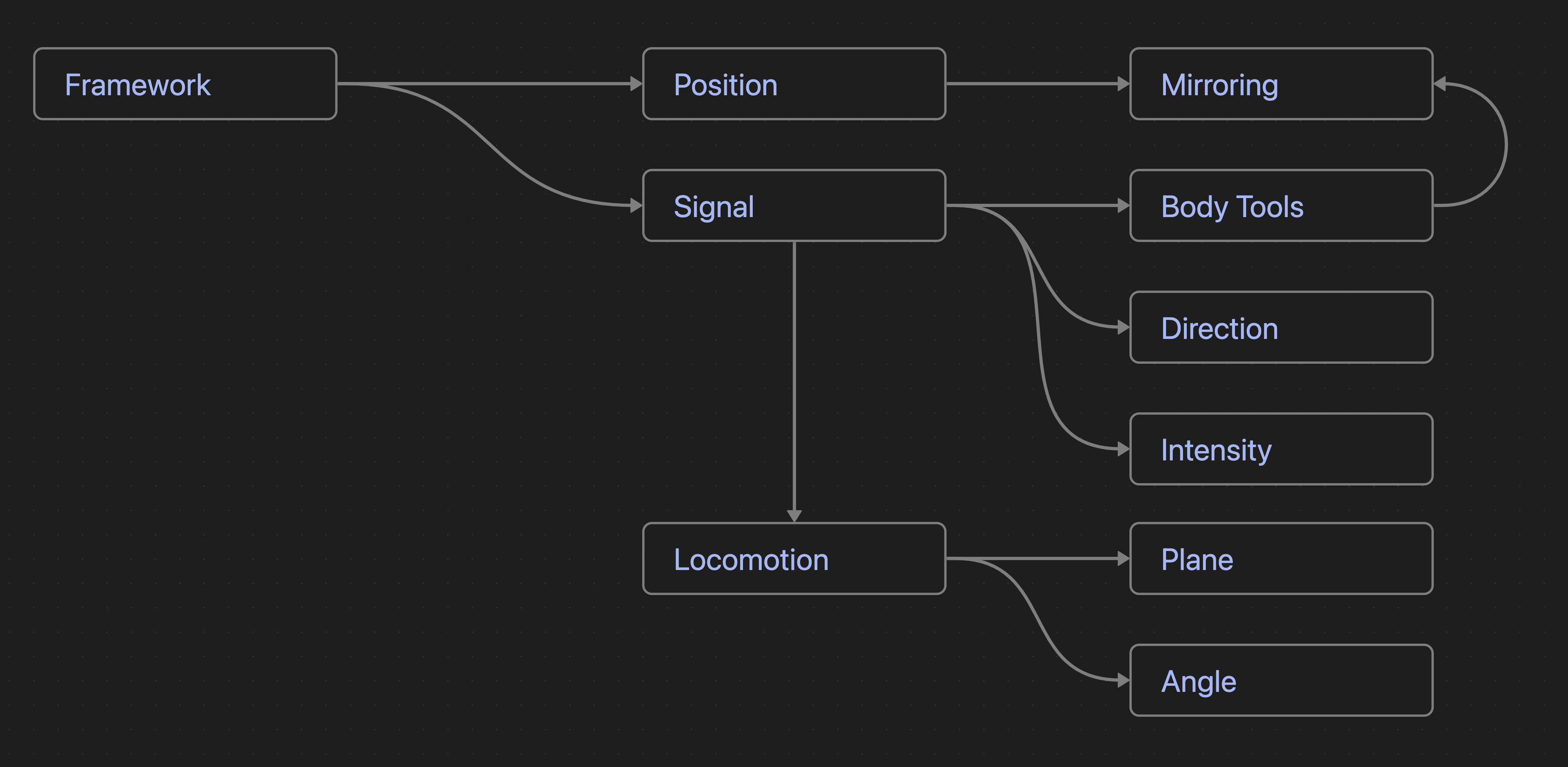
Position refers to how the dancers’ bodies relate to each other. Usually, the follower mirrors the lead. Signals are the information transmitted from the lead to the follower to indicate what is coming next. Through signals, the lead initiates movement, referred to here as locomotion.
Signals are conveyed using different parts of the body, which are referred to as body tools in this framework. These signals guide the follower into a certain direction, which is then followed by some form of locomotion. Another quality of a signal is its intensity, which influences the energy or emphasis of the movement.
In general, Kizomba is a circular dance. However, many steps are executed in short straight lines—for example, Basic 2 or Basic 3. If we imagine a Cartesian plane, like in math graphs, movement can happen along the vertical axis (Y) or the horizontal axis (X). Signals can also communicate a change in direction, either through a stop or by adding an angled step.
Position
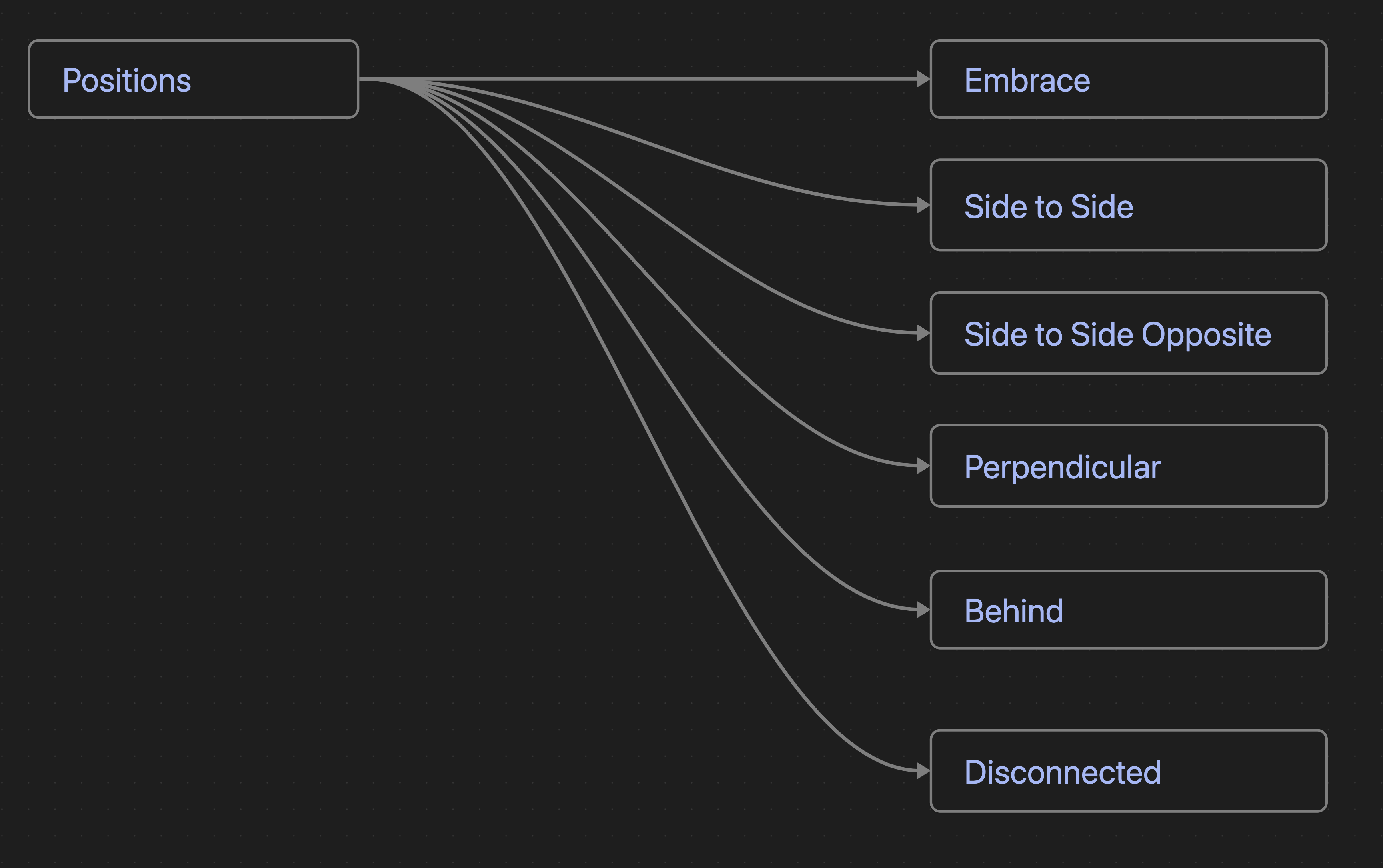
The basic position in Kizomba is the embrace, where the lead and follower face each other in a friendly, close hold. They can also be positioned side by side, facing the same direction or facing opposite directions.
The perpendicular position refers to an L or T shape, where the lead is usually facing the follower, but the follower is not directly facing the lead. This creates an angular relationship between their bodies.
A commonly used variation is the shadow position, where the lead stands slightly behind and to the left of the follower, with both facing the same direction. There are a few instances where the follower is positioned behind the lead, which I refer to as the reverse shadow position.
Finally, there are a few movements in which the lead and follower are almost entirely disconnected, with minimal physical contact or even momentary separation.
Locomotion
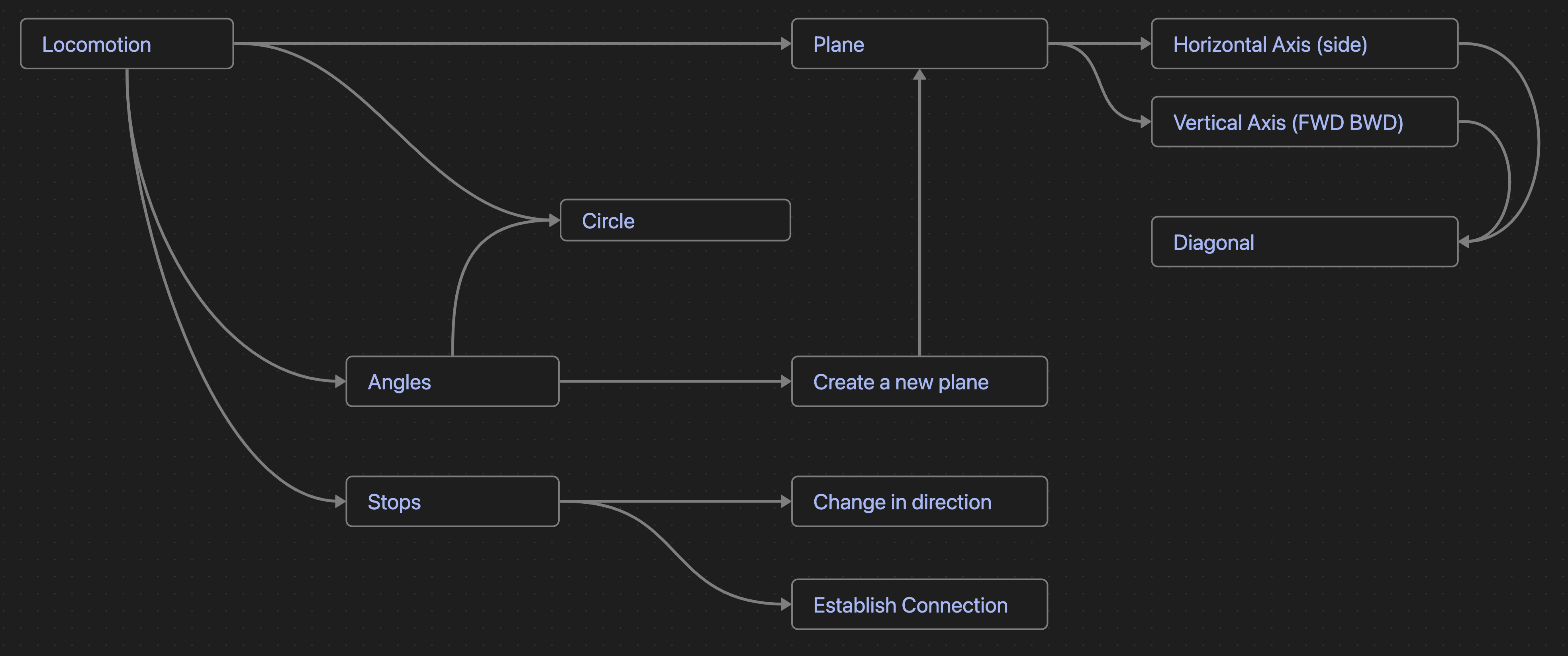
Kizomba is known as a walking dance. In this framework, movement—or the absence of it—is referred to as locomotion.
From the lead’s perspective, movement can occur forward and backward (along the vertical axis, or Y) and side to side (along the horizontal axis, or X). Diagonals are created by combining a vertical with a horizontal locomotion. Circular movements, on the other hand, are created by combining linear steps with angled steps. A series of consecutive angled steps can result in a circular pattern, as seen in movements like Corridinho. Effectively, every time an angle is added to a movement, a new plane of motion is created.
Lastly, the absence of movement is also part of this framework. Stops, such as in the movement Marca, are often used to change direction or to establish connection with the partner.
Modules
This framework is divided into five modules:
- Fundamentals: Learning how to walk together.
- Disconnections: Learning how guide disconnected steps.
- Strides: Essential walking patterns.
- Turns: Patterns involving turns and spins.
- Displacements: Advanced patterns that involve footwork.
- Figures: Advanced steps that don’t fall into any of the other movement categories.
Fundamentals
The module Fundamentals focus on teaching how to walk together with a partner in a smooth, connected manner. There is an intense focus on the follower’s physical listening skills. The techniques of this module include:
- Chest leading
- Thigh leading
- Frame
- Intensity of motion
- Right arm leading
With these techniques, the following motions should be achieved:
- Horizonta locomotion
- Vertical locomotion
- Circular locomotion
- Reverse direction
- Angled steps
Disconnections
The Disconnections module teaches how to work with a partner when they are not in the embrace position. The techniques in this module include:
- Guiding the follower around the lead.
- The lead moving around the follower.
- Line exit.
- Line entry.
Using these techniques, the following movements can be achieved:
- Disconnected Walks.
- Entradas.
- Saídas.
Strides
Once walking together effortlessly is mastered, the Strides module teaches how to perform various connected walking patterns as well as disconnected walks. The techniques covered in this module include:
- Contratempo
- Transition Steps
- Passadas
- Tempo Play
With these techniques, the following motions should be achieved:
- Retrocesso
- Diagonals
- Orbit
- V walk
Turns
The goal of this module is to enable dancers to lead and follow movements that involve turns and spins, both in connected and disconnected contexts. The techniques covered in this module include:
- Balance
- Turns
- Hammerlock
With these techniques, dancers should be able to achieve the following movements:
- Connected turns
- Disconnected turns
- Arm flicks
- Traveling turns
- Pivots
- Hammerlock
Displacement
Kizomba is well known for its manipulation of the follower’s legs—movements referred to as displacements in this framework. The techniques covered in this module include:
- Slides
- Leg Raises
- Sweeps
- Pulls
- Blocks
With these techniques, dancers should be able to perform the following movements:
- Foot slides
- Leg crossings
- Leg fishing
- Redirections
- Aerial displacements
Figures
Figures are advanced steps used to emphasize the connection with the music. Many of them incorporate pauses and less commonly used postures, such as sitting. The techniques covered in this module include:
- Supported unbalanced steps
- Sits
- Weight support
- Stops
- Pivots
- Acrobatics
With these techniques, dancers should be able to perform the following movements:
- Chair
- Dips
- Falls
- Climbs